
A sewing or embroidery machine runs smoothly for hours. But the thread does not always move that easily. It passes through guides, tension parts, and the needle at high speed. During all this, it faces constant friction. Over time, this friction leads to thread breakage, heat, static, and uneven stitching. To avoid this mess, thread lubricant comes into play. But the interesting thing is that there are many types of thread lubricants. So, how to choose the right sewing & embroidery thread lubricant? If you feel confused, don’t worry! In this guide, I will discuss common thread lubricants, their features, and how to choose the right one. So let’s get started.
What is Sewing & Embroidery Thread Lubricant?

A sewing and embroidery thread lubricant helps threads move smoothly through a machine. It creates a thin layer on the thread that reduces friction as it passes through the needle, guides, and other parts. This makes the thread easier to handle during sewing or embroidery.
Basically, a sewing or embroidery machine moves at high speed to create a stitch. During this, the thread moves back and forth very quickly. This movement creates friction and also produces heat. If this friction becomes too high, the thread will break, wear out, or cause uneven stitching. That’s where thread lubricant comes in.
A lubricant reduces this friction and helps the thread travel through these parts with less resistance. As a result, the thread feeds smoothly, and the machine produces more even stitches. Beyond this, thread التشحيم also helps with some other problems. Some threads, like synthetic ones, build up static when they move quickly through the machine. This makes the thread harder to control and creates uneven stitches. But a lubricant reduces this by lowering friction and thread wear.
JIEERQI 188 vs. Sprayidea F-18 vs. F-20: Choose The Right Lubricant
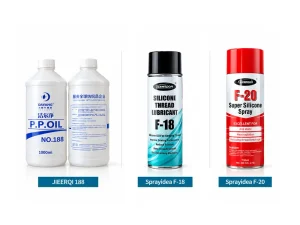
There are several thread lubricant options. Among them, JIEERQI 188, Sprayidea F-18, and F-20 stand out for their unique features. All lubricate threads, but their specialties and uses differ. Let’s look at each one so you can see what makes them different and which option best suits your sewing or embroidery work.
JIEERQI 188: The Embroidery Specialist
JIEERQI 188 is the first option for thread lubrication. It is a silicone-based lubricant. Its main job is to help the thread move through the machine more easily. During sewing, the thread keeps passing through guides, tension areas, and the needle. This movement automatically creates friction. JIEERQI 188 lubricates the thread. This means less rubbing as it moves through these points.
Another thing that makes JIEERQI 188 handy is its focus on reducing heat along with friction. When a machine runs quickly, the thread is moving again and again at high speed. The needle also becomes hot during this continuous movement. But when you apply JIEERQI 188, it reduces friction, which reduces overheating. Moreover, JIEERQI 188 isn’t limited to one thread type.
JIEERQI 188 works for cotton, silk, polyester, nylon, and blended threads. It is handy for sewing and embroidery work where you have to change the thread constantly. With JIEERQI 188, you don’t need multiple thread lubricants. It works with almost every thread material. Another worth-noticing point is its viscosity. JIEERQI 188 has a viscosity of almost 800–1000 mPa·s.
Viscosity is about how easily a liquid flows. A higher-viscosity lubricant is thicker than a very thin oil. This thickness provides a lasting lubricating layer on the thread. JIEERQI 188 also has a low-odor formula and is eco-friendly. Its shelf life is 24 months. But when should you choose JIEERQI 188? Basically, it makes sense when thread friction, heat, and breakage are your main concerns. Also, if you want a silicone-based lubricant that can work with several common thread types, JIEERQI 188 is the best.
Sprayidea F-18: The Static Eliminator
Sprayidea F-18 is an antistatic silicone oil spray made for sewing threads. Its main difference is right in its name. As the name suggests, it reduces static electricity and lubricates the thread. As I said above, the thread moves quickly through a sewing or embroidery machine.
It rubs against different surfaces, static builds up. When that happens constantly, the thread does not move or behave as smoothly. A thread that picks up static becomes harder to control and does not stay where you expect it to. F-18 is specifically made to reduce this static effect. It helps the thread move smoothly and easily so static electricity doesn’t build up.
It is a high-purity misty silicone oil that forms a durable coating. This coating lasts for days, does not disappear quickly, and provides continuous lubrication. F-18 is also made with different embroidery threads in mind. It can work with cotton, silk, wool, and polyester. Choose F-18 if static electricity is your biggest problem. It is best when the thread becomes difficult to control during fast sewing.
Sprayidea F-20: The Versatile All-Rounder

Not every sewing or embroidery project uses the same thread or speed. One day, you work with polyester thread. The next day, you might need to use cotton, silk, wool, or another material. The machine also runs for a short task or keeps running for several hours.
This is where a versatile thread lubricant comes into play. سبراديا F-20 is a reliable option when you need something that helps you with different sewing and embroidery needs. First, F-20 helps the thread move more smoothly through the machine. Thread does not travel in a straight line from the spool to the fabric.
It passes through guides and other parts before reaching the needle. Every contact point creates some rubbing. When this happens repeatedly, the thread wears out faster. But the F-20 reduces this problem by offering the right level of lubrication. Secondly, the F-20 works well with different thread types.
Basically, when you work with different thread materials, you don’t know each one’s nature. Some might create more friction, while others may be more affected by static or heat. In that case, a product designed for general thread lubrication can help. And that product is F-20 thread lubricant.
However, that doesn’t mean F-20 is automatically the right choice for every machine or every thread. It works best with certain thread types, such as cotton, silk, wool, polyester, and rayon. It makes sense if you are looking for a versatile option for regular sewing and embroidery work. Also, if you want to cope with general thread movement rather than one specific problem, F-20 is suitable.
Buying Guide: Which Thread Lubricant Should You Choose?
As you can see, many thread lubricants are available for sewing and embroidery machines. So it often becomes hard to choose the most reliable option. But remember, the wrong lubricant can affect your machine or even your stitching. So before you choose one, consider these factors.
- Thread material: First of all, start with the thread itself. Sewing threads come in cotton, silk, polyester, nylon, wool, rayon, and blends. But the problem is that they all behave differently inside a machine. Some of these threads rub more against the machine parts. At the same time, some are more likely to create static. So know the thread you are using, then choose the lubricant that suits it.
- Main problem: Secondly, know why you need a lubricant. Are you dealing with thread breakage? Does the thread feel like it is rubbing too much? Are you noticing heat during long machine use? All of these issues are common. So once you know the main issue, your options narrow. Then choose a thread lubricant that addresses it.
- Static control: Static electricity is a real nuisance when the thread moves quickly. The rubbing between the thread and machine parts creates static. This is what affects how the thread behaves. As a result, it becomes harder to control the thread, or it sticks where it shouldn’t. In that case, choose a thread lubricant with antistatic properties.
- Machine/Usability: The machine you use also matters when choosing a thread lubricant. If your machine runs fast or for many hours, the thread faces more friction and heat. In this case, finding a good lubricant becomes more important. If you only sew small jobs at a lower speed, you can choose a simple, regular lubricant.
- Application & Production Requirements: Finally, think about how often you use the lubricant. If you run your sewing or embroidery machine for many hours each day, you have to buy a lubricant that suits regular use. Also, check how the lubricant is applied and how long it lasts. Make sure the lubricant you choose is easy to use and does not leave too much oil or residue on the thread or machine.
الخاتمة
In short, thread lubricants are a must-have for embroidery and sewing machines. They mainly reduce friction and help the thread move smoothly through different machine parts. In this guide, I have discovered some of the most effective thread lubricant options you can opt for. Each of those has its own strengths and best use cases. So how would you choose the right one? For that, consider your thread, machine, and daily workload. Identify the problem you are actually trying to fix. Once you know all these things, choosing the right lubricant becomes much easier.