
If you are looking for an alternative to Odif spray adhesive, you are facing one or more of the following problems. The cost is rising. The supply is irregular. Or the adhesive is just not suitable for your current production pipeline.
Odif has a well-deserved reputation for marketing high-quality temporary fabric adhesive. The most well-known name in this line of products is Odif 505. It’s a great choice for embroidery, quilting, and craftwork. But it may no longer be the best choice when you transition from a hobby to a real production pipeline.
Here comes Sprayidea—a brand that has already established itself as a manufacturer of high-quality industrial and craft-grade spray adhesives. Sprayidea has an alternative for just about every Odif product. The formulations and applications are similar, but the price points are more suitable for high-volume users.
In this post, we will recommend a Sprayidea match for every Odif spray adhesive. Hopefully, this guide will help you make a better buying decision.
Why Buyers Look for an Odif 505 Alternative
Odif temporary fabric adhesive spray is a transparent, odorless, and acid-free solution for securing fabric during embroidery, quilting, basting, appliqué, binding, and sewing. Because it is VOC-compliant, CFC-free, and guaranteed not to stain fabric or gum up needles, it remains a top choice for home sewists and small studio owners.
The problem comes down to scaling. When sprayed, Odif 505 spray glue is almost like water. It does not feel like glue, almost imperceptible. So, it’s good for home embroidery.
But factories have different requirements. They need a tack that is easy to spot. They need more open time. And because they have to use adhesive throughout the day, they have to ensure that the per-unit cost is low. Sprayidea 81 and Sprayidea 82 can perfectly fill this gap.
Odif 505 vs. Sprayidea 81/82
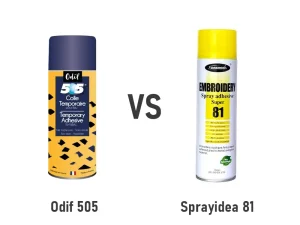
Both products basically serve the same purpose: temporarily holding the fabric in place. Later, you can just wash the adhesive with clean water. However, these two brands are formulated for two different types of production scenarios.
Advantages and disadvantages of Odif 505:
| Advantages | Disadvantages |
|
|
Advantages and disadvantages of Sprayidea 81:
| Advantages | Disadvantages |
|
|
The bottom line is, Odif 505 basting spray is still good for a home machine or a small studio. But if you run an embroidery or garment factory, you need to find something that lasts longer and costs less when bought in large volumes. Sprayidea 81 and Sprayidea 82 serve these purposes better.
Odif 404 vs. Sprayidea 80: Repositionable Adhesive for Paper and Templates
Odif 404 is a repositionable spray for paper. It works pretty well on templates, cutout patterns, and polystyrene. You can apply and reapply it many times without leaving stains. Like other Odif products, it is acid-free, VOC-compliant, and contains no CFCs. A sprayed stencil remains repositionable for a few months. It loses tack only when dust gathers.
Sprayidea 80 does the same thing. However, it works on more materials and in more conditions.
Advantages and disadvantages of Odif 404:
| Advantages | Disadvantages |
|
|
Advantages and disadvantages of Sprayidea 80:
| Advantages | Disadvantages |
|
|
If your project mostly involves working with stencils for long periods of time, you should probably lean on Odif 404. But if you need a repositionable spray adhesive for an industrial setting with more materials and higher temperatures, Sprayidea 80 can be a better alternative for you.
Odif 909 vs. Sprayidea 35: Permanent Fabric Bonding
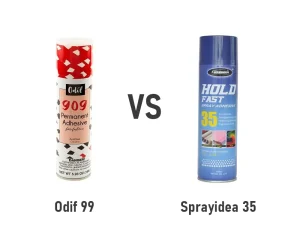
Odif 909 is a permanent fabric adhesive. It forms fast and strong bonds. This transparent adhesive is acid-free, VOC-compliant, and CFC-free. It permanently bonds fabric to other fabric, wood, cardboard, metal, and acrylic. When the glue is sprayed on both surfaces, the bond gets stronger.
Sprayidea 35, in contrast, is a general-purpose industrial adhesive. It works very well with fabric, but it also works with other materials. And its cost and packaging are very different.
Advantages and disadvantages of Odif 909:
| Advantages | Disadvantages |
|
|
Advantages and disadvantages of Sprayidea 35:
| Advantages | Disadvantages |
|
|
If your projects mostly involve high-quality fabric craftwork, Odif 909 is still a good option for you. But if you run your operations on a factory scale and use a variety of materials, then Sprayidea 35 will offer more coverage and efficiency per can.
Odif DK5 vs. Sprayidea 103: Adhesive Residue Cleaner
Odif DK5 is a glue and adhesive cleaner. It removes adhesive stains from cutter tools, such as scissors, rulers, stencils, punches, and sewing machines. Beyond crafting equipment, it works effectively on plastic, glass, stone, and ceramic. The formula dries clean, is completely odor-free, and contains no CFCs.
Sprayidea 103 is built to remove heavy adhesive. It works with a wide range of industrial materials.
Advantages and disadvantages of Odif DK5:
| Strengths | Weaknesses |
|
|
Advantages and disadvantages of Sprayidea 103:
| Advantages | Disadvantages |
|
|
The gentle, odorless formula of Odif DK5 does a good job of caring for everyday tools in a craft studio. Sprayidea 103 is a more practical choice for heavier residue removal from a wide range of materials, at real production volume.
Odif 707 vs. Sprayidea 92: Repositionable Fabric Adhesive
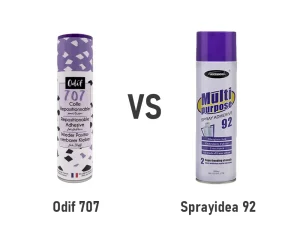
Odif 707 makes fabric, appliqué, badge, and stencil repositionable. It is ideal for temporarily placing textile motifs. Materials that are treated stay sticky. You can reposition it again and again, leaving no residue. It is VOC-compliant and contains no acid.
Strengths and weaknesses of Odif 707:
| Strengths | Limitations |
|
|
Strengths and weaknesses of Sprayidea 92:
| Strengths | Limitations |
|
|
Choose Odif 707 if you need a dedicated, residue-free spray adhesive for textile motifs and appliqué. Choose Sprayidea 92 if you want to work with various types of fabrics, foam, and composites, and need both temporary and permanent bonding.
Quick-Reference Matching Guide
| Odif Product | Function | Sprayidea Match | Why Choose Sprayidea |
| Odif 505 | Temporary fabric adhesive | Sprayidea 81/82 | Longer tack, industrial embroidery/garment production |
| Odif 404 | Repositionable paper/stencil adhesive | Sprayidea 80 | Broader materials, wider temperature range |
| Odif 909 | Permanent fabric adhesive | Sprayidea 35 | Multi-substrate, large-area, outdoor-capable bonding |
| Odif DK5 | Adhesive/glue cleaner | Sprayidea 103 | Heavy-duty residue removal, bulk industrial use |
| Odif 707 | Repositionable fabric adhesive | Sprayidea 92 | Combined temporary + permanent bonding, composites |
Choosing Between Odif and Sprayidea
It’s not about the superiority of one brand over another. Odif’s formulas are known for their precision. They leave less residue and offer tight control. Home sewists, quilters, and small studios are likely to find these products more suitable.
Sprayidea’s products have the same core chemistry, but they are intended for higher volume and cost less. The cans are larger, and the products work with more materials. And specifications like temperature range, coverage, and open time become important when you use adhesives regularly in a factory setting.
If you are a hobbyist or running a small studio and you find the Odif products convenient, you can keep using them. But if you are scaling and would like to reduce costs, consider switching to Sprayidea. The applications and the chemical formulations are very similar. The difference lies in industrial pricing and packaging.