
Are you looking for the Top 10 epoxy spray adhesives for carbon fiber? You have come to the right place. Actually, carbon fiber is a super-strong, lightweight, and high-performance advanced material. You can often find it in cars, sports gear, aerospace, and modern construction. However, working with carbon fiber is not very easy, especially if you are new to it.
One small mistake while handling it, and the entire result will be ruined. That’s where the epoxy spray adhesive comes into play. These are special sprays that hold the carbon fiber fabric in place before you apply epoxy resin. However, not all of these epoxy sprays work equally. That’s why, to help you make the right choice, I will discuss some of the most common epoxy sprays in this guide. So let’s get started.
Top 10 Epoxy Spray Adhesives for Carbon Fiber
You will agree with me that carbon fiber work requires precision and stability. That stability is not possible with the epoxy sprays. However, with so many options available in the market, anyone can get confused. That’s why, to help you make the right choice, here I will share some of the most widely used and trusted epoxy spray adhesive brands.
1- Carbon Fiber Spray Glue
The first, most common epoxy spray adhesive is carbon fiber spray glue that holds carbon fiber fabric in place before you apply epoxy resin. As I said above, the fabric layers are very light, so they can easily move or shift while working. This shift will result in uneven surfaces, wrinkles, or weak spots in the final product. However, carbon fiber spray glue tackles this issue by providing a light, temporary hold.
What makes it stand out is its compatibility with epoxy systems. Actually, regular glues may react badly with epoxy resin. This reduces strength or leaves marks on the surface. But this carbon fiber spray glue works smoothly with epoxy. It does not interfere with bonding or curing. This means the real strength of your final product will come from the epoxy resin, not the spray itself.
2- Spray Glue Multi-Purpose Fiberglass Carbon Fiber Fabric

Spray glue for multi-purpose fiberglass and carbon fiber fabric is a special, versatile adhesive. This versatility means it works with a variety of lightweight materials. Those include carbon fiber, fiberglass, foam, plastic, and even fabric. So it suits you best, especially when you are working on composite projects.
You don’t have to use different spray adhesives, which saves time and cost. Moreover, this adhesive spray also comes with some advanced versions. Those work without disturbing the curing process of epoxy resins. This means they will not weaken the final structure of your product but will act as a temporary holding element.
3- FUSIONFIX™ EP Epoxy Spray Adhesive
FUSIONFIX™ EP is a spray adhesive made specifically for carbon fiber work. What makes it stand out is that it is based on epoxy itself. It means this spray works naturally with epoxy resin rather than fighting it, unlike many regular spray glues. So it holds the carbon fiber fabric gently in place while you set up your layers. How?
Actually, FUSIONFIX™ EP provides a soft, even hold, so you can adjust and position the fabric without stress. It doesn’t lock everything too hard. This temporary adhesion is very helpful because it gives you time to fix small mistakes. Now, when you apply epoxy resin, the adhesive becomes part of that resin and does not reduce the strength of your carbon fiber.
4- CARBOTAC 02-A Epoxy Spray Adhesive
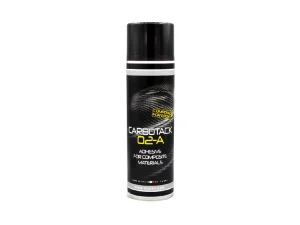
CARBOTAC 02-A is a professional-grade spray adhesive available on the market. This spray adhesive is specifically designed for carbon fiber. However, some versions can still handle composites, which sometimes makes it multi-purpose. Generally, this epoxy spray adhesive is used during the early stages of carbon fiber layup.
For example, when you are aligning and positioning the carbon fiber at the start, this spray will help you. It does not make permanent bonds. Instead, it provides controlled light stickiness, allowing you to align the carbon fiber quickly. Another great thing about this spray adhesive is its precision, which allows the carbon fiber to work cleanly and smoothly.
5- Tensorgrip TC49 Hi-Tac Spray Adhesive
Now there is another adhesive spray known as Tensorgrip TC49 Hi-Tac Spray Adhesive. It is an industrial spray adhesive designed for composite work, such as carbon fiber and fiberglass. This spray quickly holds materials in place as soon as you spray it. That’s why you can use it, especially in processes such as infusion and resin molding, where instant tack is critical.
Another useful feature of TC49 is its fine mist spray pattern. It means the adhesive spreads on your carbon fiber in very small, even droplets, not in heavy glue spots. Because of this, it does not completely soak the material or create thick buildup, but gives a smooth finish.
6- G’fix4-EP Epoxy Spray Adhesive
Another epoxy spray adhesive option is G’fix4-EP. When you need a clean, professional, and residue-free bonding process for carbon fiber, I highly suggest this spray. Unlike typical rubber-based spray glues, this one is made with epoxy chemistry. So you don’t have to worry about it affecting the strength of your epoxy resin.
Additionally, G’fix4-EP highly focuses on clean results and surface quality. Why? Because in carbon fiber work, appearance matters a lot, especially if you are working on visible parts. You might notice that normal adhesives can leave stains, cloudy spots, or sticky marks. But this spray avoids all this and helps you keep the surface smooth and visually clean after curing.
7- Airtech Airtac-2 Spray Adhesive
Airtech Airtac-2 is another epoxy spray adhesive that can help you hold the carbon fiber. It is especially used in vacuum infusion and professional carbon fiber layup. Actually, in vacuum infusion, you make carbon fiber parts using vacuum and resin flow (called infusion). Before pouring resin, you stack layers like a carbon fiber sheet, peel material, and flow layer.
But the problem is that these layers can move or shift easily. That’s where Airtech Airtac-2 spray adhesives come into play. It lightly holds carbon fiber layers in place without blocking resin later. In real carbon fiber work, Airtech Airtac-2 acts as a placement stabilizer. It helps “lock” the fabric position temporarily so every layer stays exactly where it should be.
8- Rhino RCF Saturant-Adhesive Epoxy
Rhino RCF Saturant-Adhesive is a permanent epoxy spray adhesive. Usually, spray adhesives are only for positioning and holding fabric in place. Right? However, that is not the case with Rhino RCF Saturant-Adhesive. It creates a final bond with the carbon fiber. When you want carbon fiber to stick to a surface permanently, this adhesive will do the job.
But unlike other adhesive sprays, it is slightly different. How? First, it “saturates” the carbon fiber fabric, meaning it completely soaks into the fibers. After that, as it cures, it hardens and holds everything together into a single solid layer. This is what actually creates a strong carbon fiber-reinforced system.
Quick Highlight: Remember, Rhino RCF Saturant-Adhesive spray comes in two parts. The first one, Part A, is resin, and Part B is hardener. You have to mix them before use. After mixing, it starts reacting, then thickens, and finally hardens. But after mixing, you don’t have unlimited time. Instead, you get a short period during which you have to apply it and adjust the placement of the carbon fiber fix.
9- Sprayidea 95 Carbon Fiber Spray Adhesive
Sprayidea 95 is a process-specific spray adhesive. It is designed for vacuum infusion carbon fiber manufacturing. It is convenient when working on carbon fiber production, especially with large parts such as panels. Here, the challenge is that these layers can misalign over time due to gravity and air movement. However, Sprayidea 95 at this stage creates a very light, controlled tack that holds those layers in place.
Moreover, it performs well in vacuum-infusion environments. In infusion, resin needs to flow evenly through the entire fabric stack under vacuum pressure. Right? Now, if you use regular spray adhesive, it will create “blocked zones” where resin cannot pass. However, Sprayidea 95 prevents this issue by maintaining a low volume and keeping the fiber structure open for resin flow.
10- Sikadur®-30 Epoxy Adhesive
Lastly, you can choose Sikadur®-30 spray adhesives for carbon fiber reinforcement in repair projects. In other words, it is used when carbon fiber is applied to fix or strengthen weak structures, rather than just for holding fabric in shape. Let’s suppose a concrete beam or wall needs extra strength. For this, carbon fiber sheets are bonded to it using this epoxy.
Here, Sikadur®-30 adhesive works as the bridge between the old concrete surface and the carbon fiber. After curing, it will act as a single unit. Further, Sikadur®-30 is also user-friendly due to its high viscosity. It is not runny like other spray adhesives. Instead, it comes in a thick, paste-like form. Such high viscosity helps it stay in place even on vertical or overhead surfaces.
Important Factors to Consider Before Buying Epoxy Spray Adhesive
As you can see from the above section, there are many options available for spray adhesive. But those are not similar and work differently. That’s why you must choose the right one for your carbon fiber project. Don’t know how? Worry not! Here are some factors to consider before buying an epoxy spray adhesive.
- Compatibility with Epoxy Resin: First, check whether the spray adhesive works well with epoxy resin. As you know, carbon fiber parts get their real strength from epoxy resin, not from the spray itself. So if that spray is not compatible, it can lead to problems like weak bonding and uneven curing later.
- Clarity (Transparency): In carbon fiber projects, appearance matters a lot. So, secondly, you have to look at the adhesive’s clarity and how it looks after curing. If the adhesive leaves cloudy spots or yellow marks, it can ruin the final look. So I suggest always preferring clear or residue-free spray adhesives.
- Temperature Resistance: During the curing process of carbon fiber, heat is applied. You must choose a spray adhesive that handles this heat and stays stable. If the adhesive cannot handle heat, it will melt, lose its grip, and create defects in the surface.
- Ease of Use: Lastly, you must also consider the ease of use for spray adhesive. You must choose the spray adhesive that flows smoothly in even layers without dripping or overspraying. Also, if the spray is too fast or difficult to control, it will lead to mistakes.
Frequently Asked Questions
Is spray adhesive strong enough on its own?
No, spray adhesive is not strong enough on its own for carbon fiber work. Instead, it only temporarily holds the carbon fiber fabric in place while you arrange the layers.
Can I reposition carbon fiber after spraying?
Yes, in most cases, you can reposition carbon fiber after spraying epoxy spray adhesive. When you first spray it, the adhesive is still “wet” or lightly tacky. During this stage, you can adjust, move, and align the carbon fiber fabric. After that, the spray starts to harden, and you cannot reposition the carbon fiber.
How long does epoxy spray take to dry?
Drying time for epoxy spray adhesive is usually very fast. However, this time varies depending on the brand, the amount sprayed, and the room conditions.
Conclusion
In conclusion, working with carbon fiber is not always easy. It is very light and can easily move or lose its shape. To hold it in place, epoxy spray adhesives play a key role. But you will find hundreds of options for epoxy spray adhesive on the market, each varying in several respects. That’s why it might be confusing to choose the right one. That’s why, to make this selection easier, I have discussed some trusted epoxy spray brands in this guide.
These are known for their special features and ease of use. Even if you are totally new to working with carbon fiber, these spray adhesives will help you a lot. Before making the final decision, you must ensure the spray is compatible with the epoxy resin. Also, it has transparency and resists high heat during curing.