
Your embroidery design is loaded, and your machine is warmed up. Then comes the inevitable—the fabric shifts inside the hoop, and the embroidery stabilizer wrinkles. The whole project is ruined in seconds. Does this sound familiar?
You know it well that your hooping technique is not the problem. There is a missing link in your preparation: you are not using the right temporary spray adhesive for embroidery. This small mistake can lead to frustration, and you may spend hours cleaning sticky needles.
This post is all about helping you choose the best spray adhesive for machine embroidery. Here, you will learn about the chemistry of these products and their application techniques. Hopefully, this knowledge will help you achieve professional-grade results.

Temporary Spray Adhesive Is Essential for Embroidery
Spray adhesive for embroidery is a type of fabric security. It basically creates a temporary yet secure bond. The bond locks the fabric and stabilizer together. It is useful as long as the stitching process is on. For high-quality results, stability is crucial.
Why Does Machine Embroidery Require a Temporary Spray Adhesive?
The process of machine embroidery puts stress on the fabric. The rapid movement of the hoop and the needle penetration at speed causes congestion and torque. Due to this force, the fabric creeps, pulls, and shifts. This is the issue with knits, fleece, and velvet. As a result, the stitching gets misaligned, and the design gets distorted. This problem is called “registration error”.
To address this issue, embroiderers use a temporary spray adhesive for embroidery. When you use it, the fabric and the stabilizer act like one unit. There is no movement, and that ensures the integrity of the design.
Embroidery temporary spray adhesive is absolutely worth it for complex designs that take hours to complete. It saves not only your time but also your materials. Without it, you will frequently have to deal with issues like fabric creep and stitch distortion.
Hooping Can Be Tricky
Even if a hoop is perfect, sometimes it can fail. Some materials resist a tight grip. The hoop pressure causes knits to stretch. Terry cloth and other napped fabrics tend to compress unevenly. That is where float hooping comes in. In this method, you only have to hoop the stabilizer. Then you have to stick the fabric on top.
Thus, you can avoid marking or stretching delicate materials. This holding power is crucial for this float hooping technique. To ensure this, investing in a quality embroidery spray is essential. Even during fast jumps or dense fills, a high-tack spray offers a firm bond.
What Makes a Spray Adhesive Great for Machine Embroidery?
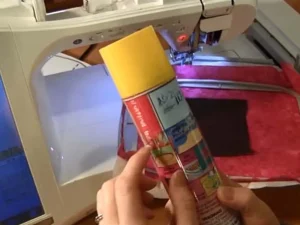
If you are looking for the best temporary adhesive spray for embroidery, know that the strongest glue is not necessarily the best. Finding the balance is the key. The adhesive must form a bond, but the bond must be temporary. Also, the adhesive has to be needle-friendly.
The “Temporary” Factor
The temporary nature of your adhesive is the key here. The bond must be strong yet gentle, so that you can easily remove the fabric. Once the embroidery is done, there should be no residue. That means you have to choose an adhesive that breaks down.
Needle problems are pretty common when working with embroidery spray adhesive. A low-quality formulation will definitely cause build-up, known as needle gunk. The thread can break, resulting in skipped stitches. So, make sure you check the formulation when choosing the best spray adhesive for embroidery.
What to Look For in the Best Temporary Spray Adhesive for Embroidery?
When evaluating products, there are three things to look for.
First, look for an adhesive with high tack that provides instant grip without leaving a gummy residue.
Second, make sure the adhesive is odorless (or at least low-odor) and colorless. It will improve your working experience, and you will not have to worry about staining fine fabrics.
And third, make sure the adhesive does not contain any acid that may be unsafe for the fabric. The best temporary spray adhesive for embroidery should have all three characteristics.
The wisest choice is a dedicated machine embroidery spray adhesive. Spray adhesives specifically formulated for machine embroidery will offer the best results.
How to Use Spray Adhesive for Stabilizer and Fabric
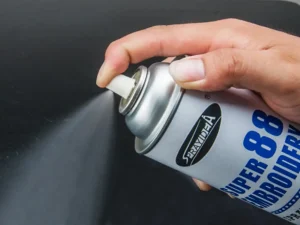
If you do not know how to apply spray adhesive correctly, even the best product will not yield good results. So, to get the best out of your spray adhesive for stabilizer, keep the following things in mind:
Pre-Application Checklist
Before you start spraying, prepare your workspace. Work in a well-ventilated area. Keep the machine and floor clean. To catch any overspray and protect your work table, consider using a dedicated cutting mat. Keep the stabilizer hooped tightly. The adhesive is not a substitute for proper hooping; it is just reinforcement.
Spray Correctly, Avoid Misuse
As you spray, make sure the spray is a fine mist, not a thick and wet coating. Avoid holding the can too close to the stabilizer; they should be 10 to 12 inches apart. Spray in a smooth and sweeping motion. Spot the area where the fabric contacts the stabilizer, and cover that area.
Ideally, the coat should be light, almost invisible. If you spray too much adhesive, there will be problems. You may find residue on the fabric, or the needle might get gummy. How do you know if you are using too much? Just check if the surface looks wet. When applying spray adhesive for fabric embroidery, less is definitely more.
Laying the Fabric
Make sure the stabilizer has a light and even layer. Lay the fabric on top of the stabilizer. Smooth the fabric. Start from the center and move outwards. There should be no wrinkles underneath. In general, the adhesion is instant.
Now you have prepared the fabric and stabilizer combination. So, you can load it onto the machine—the process is called “floating the fabric”. If your fabric is too thick to hoop, this process will be useful. It is also good for delicate fabrics. This is basically how you use temporary spray adhesive for machine embroidery.
Mistakes That Can Ruin Your Embroidery Project
For professional embroiderers, learning how to use spray adhesive is crucial. At the same time, you should also know what not to do. There are a few things to avoid:
Using a General Purpose Spray Adhesive for Fabric Embroidery
By all means, do not choose permanent spray adhesive for your project. It will ruin your fabric. Permanent spray can even ruin your machine because it often contains harsh, sticky chemicals. When buying the best spray adhesive for embroidery, make sure the label explicitly states that the spray is temporary or repositionable.
Overspraying and Sticky Needles
Do not apply the adhesive excessively. If you do so, you will have to stop frequently to clean the needle. You might also have to replace the broken thread again and again. Overspray is always bad. Also, the sticky residue can cause friction. If it is thick enough, the thread can get seized up. And that will result in machine tension and fluctuation. You can avoid all these issues just by spraying less. And do not hold the can too close.
Inadequate Ventilation
As you apply spray adhesive, fine particles are released into the air. While most modern products have low levels of toxic chemicals, do not inhale them directly. Just make sure your workspace is well-ventilated. Ideally, you should work outdoors. However, if you want to work indoors, point the nozzle into a waste bin.
Finding the Best Adhesive Spray for Embroidery
What is the best spray adhesive for machine embroidery? To some extent, that depends on the type of fabric you are working with. Look for textile-specific formulations. They leave minimal residue and offer needle-friendly, temporary tack.
The ideal product is the one that offers a strong tack and holds slippery fabrics, such as silk and satin. We recommend Sprayidea Super 88 as the best adhesive spray for embroidery. It provides reliable temporary tack, is non-staining, and causes little to no needle gumming. It also has a low odor.
However, if you work with large, heavy garments, maximum hold is needed. Sprayidea 85 is formulated exactly for this purpose. It has an unmatched holding power. However, be cautious with the application. Do not overspray and avoid excessive residue.
Conclusion
Choose a product that offers temporary tack and is formulated for use with textiles. If your project requires a relatively strong hold, choose accordingly. Spray adhesive for stabilizer must offer a balance between tack and separation.
I hope you have found this article useful, and you are ready to fight the fabric shift. It all comes down to learning about your options and choosing a spray adhesive that helps you achieve professional quality.